
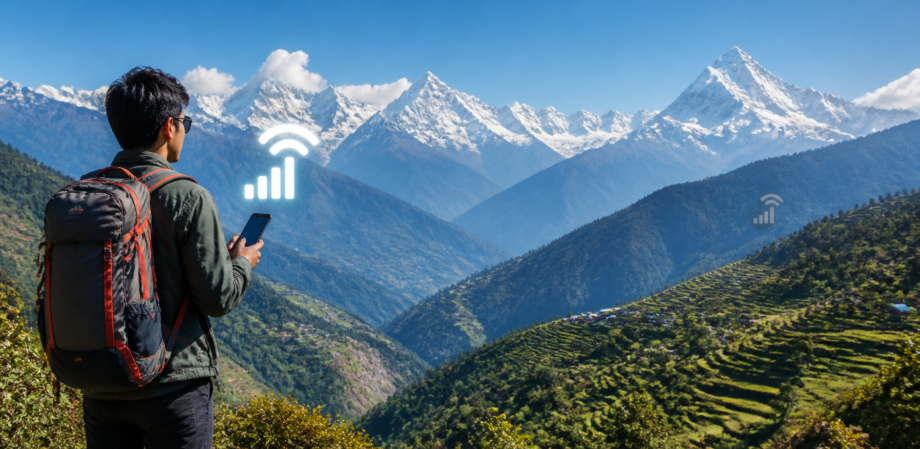
If you’ve ever traveled through Nepal with a phone in your hand, you already know—network here is kind of an adventure on its own. One minute you’re posting a photo with full 4G, next minute… no signal, just you and the Himalayas. It feels random, but there’s actually a long story behind why things are the way they are.
Nepal didn’t always have this kind of connectivity, of course. Go back about a hundred years, and communication looked completly different. The first real telecom step happened in 1913, when a telegraph line connected Kathmandu to Raxaul in India. It sounds simple now, but at the time it was a huge deal. Still, it wasn’t for everyone—mostly government and elites used it.
Then came telephones, around 1914. But again, very limited. A few lines in Kathmandu, mostly for officials. If you were a normal person living in a village, this kind of tech was basicaly non-existent. Information still moved the old-fashioned way—word of mouth, letters, or someone physically carrying messages across hills and rivers.
Even after Nepal opened up politically in 1951, telecom growth stayed slow. The geography didn’t make things easy. Building anything across steep mountains and remote valleys is tough, expensive, and sometimes just impractical. So for a long time, communication development lagged behind.
Things started to shift in 1975 when the Department of Telecommunications was formed. That was like Nepal saying, “okay, we need to take this seriously now.” Even then, services were limited and mostly urban. If you went far outside cities, don’t expect much signal—or any at all.
Fast forward to the 1990s, and this is where it gets interesting. Nepal began opening up its economy, and telecom was part of that change. In 1997, Nepal Telecom (back then Nepal Telecommunications Corporation) came into the picture. Around the same time, private companies were allowed to enter the space.
And then—mobile phones arrived.
Nepal Telecom launched mobile services in 1999. At first, it was kind of a luxury thing. Phones were expensive, calls were expensive, and coverage was… let’s say, not great. You couldn’t just rely on it everywhere. Still, people started getting curious, and slowly mobile usage picked up.
The real game changer came in the early 2000s with Ncell (originally Mero Mobile). When they entered in 2004, competition finally became real. Prices dropped, offers improved, and suddenly more people could afford mobile services. Both companies started expanding faster, trying to reach more users across the country.
Now here’s where Nepal stands out: expanding networks here isn’t like doing it in flat cities. You’re dealing with mountains, landslides, unpredictable weather, and places where even reaching by road is difficult. Installing a mobile tower in such areas is not just technical—it’s almost an adventure. And maintaining it? Even harder.
Still, progress has been impressive.
By the 2010s, mobile phones were everywhere. Even in remote villages, you’d find people using basic phones. Then came mobile internet—3G in 2007 and 4G in 2017. That changed everything. Phones were no longer just for calls; they became lifelines for information, work, and staying connected.
If you’re traveling in cities like Kathmandu or Pokhara, things feel pretty normal. Fast internet, decent coverage, easy access. But once you start heading into trekking routes or more rural regions, things get a bit unpredictable again. Sometimes you get strong signal in the most unexpected places, and sometimes you get nothing where you really need it.
That’s part of the Nepal telecom experience, honestly.
Mobile networks have also changed daily life in a big way. Farmers check market prices, students watch online classes, and families stay in touch across countries. Digital payments and mobile banking are growing too, though not everywhere equally. The digital divide still exist, especially between urban and rural areas.
To improve this, the government has tried initiatives like the Rural Telecommunications Development Fund. The idea is to bring connectivity to places private companies might ignore. It’s a good step, but progress can feel slow in some regions.
Looking ahead, Nepal is exploring newer tech like fiber expansion and even 5G discussions. But rolling out advanced networks in a country like this isn’t simple. Cost, terrain, and infrastructure all play a role. It’s not just about launching something new—it has to actually work across mountains, not just cities.
So yeah, using mobile networks in Nepal can feel a bit inconsistant at times. But when you think about where it started—from a single telegraph line to nationwide mobile coverage—it’s honestly pretty amazing.
And maybe that’s part of the charm. You don’t always get perfect signal, but you do get a story with it.